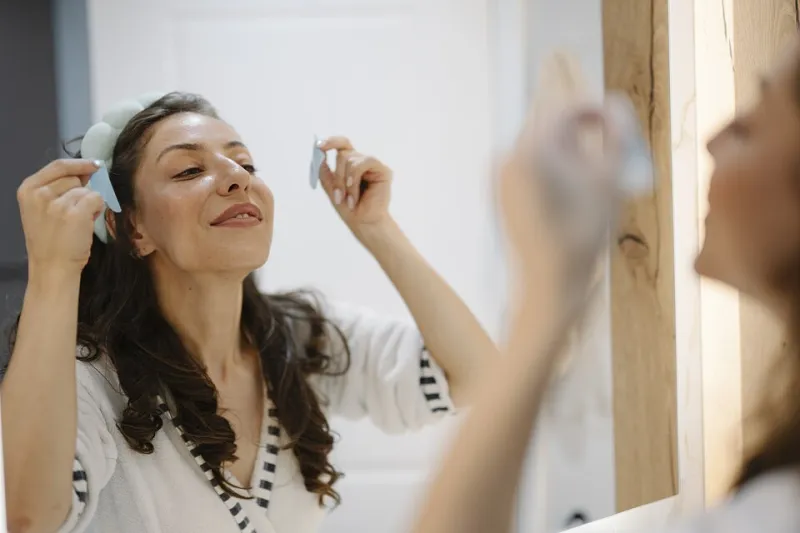
The Ritual Effect: Why Your Skincare Routine Is Quietly Keeping You Sane
It's 10:47 on a Thursday night. You're behind on emails, the news is doing what the news does, and your brain hasn't fully stopped running since roughly 7 a.m. But you're standing at your bathroom sink, running warm water over your hands, reaching for your cleanser — and somewhere in that small, ordinary act, something in you softens.
You didn't solve anything. Nothing external changed. And yet.
If you've ever felt that inexplicable sense of calm that comes from moving through a skincare routine or sitting down to do your makeup, you're not imagining it. That feeling has roots — neurological, psychological, deeply human ones. And understanding why it works might just change how you think about self-care entirely.
More Than Moisturizer: What's Actually Happening in Your Brain
Rituals — repeated, intentional sequences of behavior — have been studied extensively in psychology and behavioral neuroscience. What researchers have found is surprisingly consistent: ritualistic behavior reduces anxiety, increases feelings of personal control, and helps regulate the nervous system, particularly during periods of stress or uncertainty.
Dr. Cristine Legare, a cognitive scientist at UT Austin who studies ritual behavior, has described rituals as a kind of "anxiety buffer" — they give the brain a structured sequence to follow when everything else feels unpredictable. The pattern itself is the point.
Your evening skincare routine? That's a ritual. The intentional order — cleanse, tone, serum, moisturize — creates a predictable loop that your brain begins to associate with safety and transition. Over time, just starting the sequence can begin to trigger a relaxation response, almost like a Pavlovian cue for calm.
And then there's the physical dimension. The warmth of water, the texture of a cleanser, the scent of a face oil — these sensory inputs activate the parasympathetic nervous system, the part of your nervous system responsible for the "rest and digest" state. It's the biological opposite of fight-or-flight. You're not just washing your face. You're literally signaling to your body that it's safe to come down.
The Container Theory of Self-Care
There's a concept in therapy called "containment" — the idea that having a defined, safe structure helps people process difficult emotions without being overwhelmed by them. Rituals function similarly. They create a container: a beginning, a middle, an end. A space that belongs to you.
In a culture that glorifies constant productivity and availability, having a ritual that is genuinely yours — not optimized, not productive, not for anyone else — is a quiet act of resistance. It says: this time, this space, these few minutes, are mine.
That's not a trivial thing. For a lot of people, especially women who spend enormous amounts of energy managing others' needs, a skincare routine might be one of the only moments in the day that is fully, uncomplicatedly self-directed.
Tanya, a 38-year-old teacher and mother of two in Portland, Oregon, describes her nightly routine as "the only part of my day where I'm not performing for anyone." She doesn't use elaborate products. It's a drugstore cleanser, a prescription retinoid, and a thick moisturizer. "But I do it slowly," she says. "I take my time. And by the time I'm done, I feel like I've come back to myself a little."
That coming back to yourself — that's the ritual effect.
Why Makeup Can Be Meditation (When It's On Your Own Terms)
The conversation around makeup and mental health is often framed in opposition: either it's empowering or it's oppressive, a mask or a canvas, confidence-building or anxiety-inducing. The reality, as usual, is more nuanced.
For many people, the act of applying makeup — the focus it requires, the small decisions, the physical attention to the face — functions as a form of active mindfulness. It's hard to spiral into anxious thinking when you're concentrating on blending out a sharp liner wing. The task demands presence.
This isn't so different from what happens in formal mindfulness practices. The goal isn't to empty the mind; it's to anchor attention to something immediate and sensory. A breath. A brushstroke. The warmth of a beauty blender against your cheekbone.
The key distinction is intentionality. Makeup applied in a frantic rush, driven by external pressure or insecurity, doesn't carry the same psychological benefit. But makeup applied slowly, with curiosity and a degree of enjoyment? That can genuinely shift your internal state.
Ritual as a Form of Self-Respect
There's something worth sitting with here: the idea that showing up for a routine — even a small one, even a simple one — is a form of self-respect in action.
Self-respect isn't always a feeling. Sometimes it's a practice. It's doing the thing that says I am worth tending to even on the days when you don't fully believe it. And rituals make that practice tangible. They turn an abstract intention into a concrete, repeated act.
Self-compassion researcher Dr. Kristin Neff has written about the importance of "caring actions" as a component of self-compassion — not just feeling warmly toward yourself, but actually doing something that reflects that care. A beauty ritual, at its best, is exactly that.
It doesn't have to be expensive. It doesn't have to be elaborate. It just has to be yours, and it has to be consistent enough to become a signal — to your brain, your body, your sense of self — that you matter enough to come back to.
Building a Ritual That Actually Grounds You
If you want your routine to carry more psychological weight, a few intentional shifts can make a real difference:
Slow it down. Even by 30 seconds. Rushing through a routine keeps you in a task-completion mindset. Slowing down shifts you into presence.
Engage your senses deliberately. Notice the temperature of the water, the scent of your products, the feeling of your fingertips on your face. Sensory engagement is what activates the calming response.
Bookend your day with it. A morning ritual signals "I'm ready to begin." An evening ritual signals "I'm allowed to stop." Both are psychologically powerful transitions.
Protect it like an appointment. Not every day will allow for a full routine, but treating it as a genuine commitment — rather than an optional extra — reinforces its value to your subconscious.
Let it be imperfect. A two-minute version still counts. The ritual isn't about perfection; it's about showing up.
The Quiet Revolution Happening at Your Bathroom Sink
Nothing dramatic happens when you do your skincare. Your circumstances stay the same. The world outside your bathroom doesn't shift. But something inside you does — incrementally, reliably, over time.
That's not magic. That's neuroscience. That's psychology. That's the deeply human need for pattern, for sensory comfort, for a moment that belongs entirely to you.
Your beauty ritual isn't a luxury or an indulgence or a vanity. It's a practice. And like any practice — meditation, journaling, a morning walk — its power compounds the more consistently you return to it.
So the next time you're standing at your sink, going through the motions of a routine that feels almost too small to matter — know that it matters more than you think. You're not just taking care of your skin. You're taking care of yourself.